Built Environment
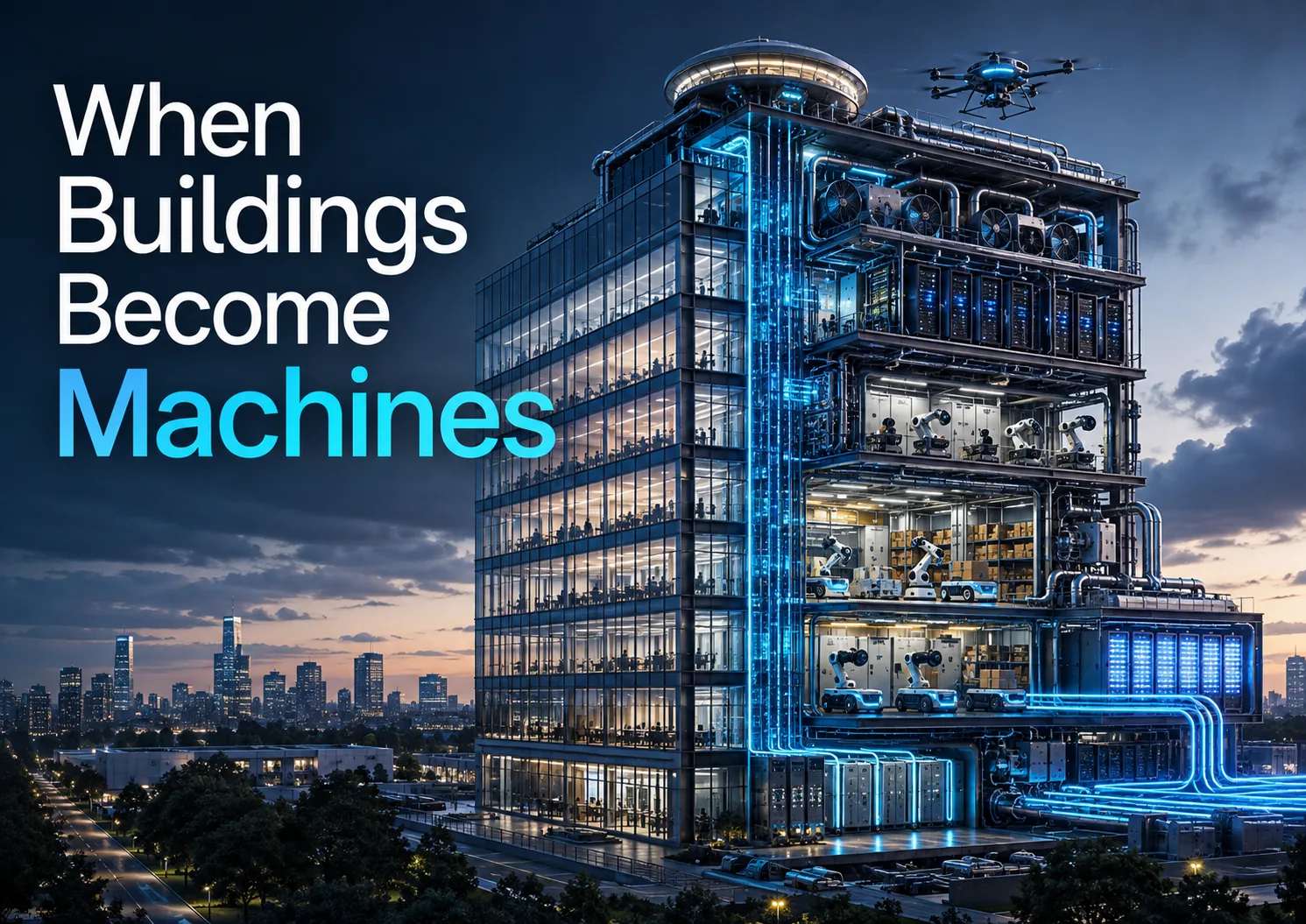
When Buildings Become Machines
AI may mean fewer people inside buildings, but far more intelligence, power, automation, and infrastructure per square foot.
Read the full essay → Promptivity
WRITING BY STUART FEILDEN
A living thesis.
This is a long-horizon investigation into buildings and infrastructure as intelligence, machines, energy, computation, and new industries move into the physical world.
It asks how robotics, computation, energy systems, manufacturing, science, economics, and industries that do not yet exist may create new physical demand—not simply how today’s buildings become smarter.
The investigation holds two futures at once: adapting long-lived buildings and infrastructure already in use, and creating genuinely new typologies for greenfield environments. Neither is treated as a secondary case.
Anchor hypothesis
Buildings may evolve from passive containers into active systems that compute, produce, coordinate, adapt, and increasingly perform work.
This is a provisional hypothesis, not a conclusion to defend. The work tests where it holds, where it fails, what might cause the change, and what alternative explanations fit the evidence better.
Longer term, that may expand what we call smart buildings into something broader: the engineering and operation of increasingly autonomous physical environments.
CURRENT EXPLORATIONS
Published essays exploring the thesis from different time horizons, from what the built environment may become to what those changes could mean for the industry today.
AI may mean fewer people inside buildings, but far more intelligence, power, automation, and infrastructure per square foot.
Read the full essay →Why the next smart-buildings cycle may favor providers that turn integrated technology into integrated operations, centralized intelligence, and stronger operating economics.
Read the full essay →HOW I APPROACH THE THESIS
I explore plausible future states, test them against technological, physical, economic, and adoption constraints, then work backward to the implications and choices visible today.
Continue the investigation
Promptivity holds the thesis map. Stuart’s Substack remains the canonical home for the complete published work.